
As part of the teams ongoing research, I've completed a short two page document analysing Katherine Isbister and Clifford Nass' study, 'Consistency of Personality in Interactive Characters.'
 Players in Warhammer Online: Age Of Reckoning demonstrate distances in MMORPGs.
"E. Hall's 'The Silent Language’ is an interesting source describing the myriad aspects of culture. While the book is probably required reading for anthropologists, I at first struggled to find meaning within it as relating to games design. Nonetheless riveting, it was only as I approached chapter ten, ‘Space Speaks’, which discusses from a Western point of view how distance affects communication. Within a three-dimensional space such as our level, this is integral."
Defining important characteristics of NPCs can be difficult, Alistair from dragon age could be characterised as a snarky wimp or a reluctant hero. Patrick O’Luanaigh opens his character design section of his book Games Design Complete, with the statement that characters need to be unique to be interesting. While seemingly an obvious point to make, it is hard to make a truly unique character. His main point in the section seems to be to just not make a bald hard man marine/space marine nowadays, which sadly is probably true.
Elaborating on this comes a section detailing how a hero or characters imperfections make them; the mistakes they make, as well as personal quirks that make them interesting. Although he doesn’t give any examples of what these flaws might be, the questions raised are no less relevant. For example Alistair’s flaws are that he is weak wiled and easily led, these are believable flaws for a realistically human character to make. It is important to note that characters traits and flaws need to be believable in the context of the character. An anthropomorphic rabbit jumping 20 foot is believable, Alistair jumping 20 foot is not.
Next the author moves on to describing some of the character designs he considers great, and why he things so. The character for me that stood out from the list is Solid Snake from the Metal Gear and Metal Gear Solid series’. Snake is by all definition a nameless soldier, completely clichéd at a superficial level. But snake is also a person with flaws, a character, and an entirely believable and heroic personality.
“He smokes, he’s rude to people, and he’s a ruthless killer. Yet as a player, you want him to win, and he makes a great lead character.”
The characters graphical design is also important, in order to define a players first impression of a character, how they look is going to be every bit as important as the first thing they say. O’Luanaigh describes a few of his favourite characters 2 of them, the lemmings and sonic the hedgehog, initially had very little personality outside of their appearance. It is the unusual, strange characteristics that are picked up on the most, such as the lemmings green hair or Sonics athletic appearance. For our project the importance of character design will be looked into, remodelling the characters where necessary to fit our purpose.
Moving on to the next section the author starts to discuss the different types of characters that can be used, categorised as animal, object, weak human, superheroes. Animals and objects don’t help us much, for our purposes though there is a lot of good theory in the weak humans section. One of the examples used was the secondary character, Yorda, in the game Ico. Yorda is a weak , pale girl the main character Ico has to protect constantly. One of the primary mechanics in combat in Ico is to save Yorda from the shadow monsters that are dragging her away. Subtle touches such as the ability to hold her hand to make her speed up, while doing this changing direction will cause her to stumble and try to catch up to Ico. As a result the player takes on the role of her protector, without meaning too. While the fact that she is largely useless may annoy at times, because the player feels they are her protector, they are automatically endeared to her.
Next is what I consider the most section of the creating characters chapter, Incorporating Unusual Emotions or Goals. This chapter details how to give characters a three dimensional character, using unusual emotions or goals. Fear is an interesting one, initially remarking that fear is rarely accurately portrayed in video games. The example he uses is a character firing a gun, instead of shooting two guns at once, shooting enemies in the head etc. Actually game examples he uses is Yorda from Ico again, while I can kind of see it I believe a far better example would be the protagonist of Silent Hill, Harry Mason. For one thing Harry is the character the player is controlling, Harry is a bad shot with guns by design, most of the time the best way to deal with enemies is to flee from them, as a result the player is also dreading every interaction with enemies as a result. From a characterisation point of view the animation of nervousness and inability to shoot accurately in Silent Hill makes it clear that Harry himself is terrified.
The example used for revenge is far more appropriate, Fable. The story of the first Fable game revolves around the main characters quest to get revenge on the bandits that destroyed his village and killed his family. Although past the first 15 minutes of game play there isn’t a lot of story that reinforces this, it does serve its purpose early on, it gives the player the motivation to get past the tutorial areas and find the person responsible for the families’ death.
Important Questions to Ask in Designing a Character, is the title of the next section. For us this is a very interesting section, as this is exactly the kind of question to ask. Although it doesn’t really move into any areas we haven’t looked into before, it does give a decent description of some of the things that should be looked into, such as how a player reacts to being chased or moves. There are only a few brief points that actually help our project in a meaningful way. Most specifically Non Controllable Teammates, the author describes the importance of having the NCT not annoy the player by being mechanically useless, or have pathing errors etc. This is all stuff we have already said for the project but having a source corroborating it is always helpful.
While this book is largely on things we already know, it is a good source of new information, because it covers all aspects of games design I may do a source analysis of the level design chapters.
 Dragon Age: Origins [Bioware, 2010]'s Alistair and Morrigan, the example characters from my report.
During Week 3 I borrowed C. Crawford's 'Chris Crawford On Interactive Storytelling" from the University library.
I completed reading the book over the course of the week, and the source analysis report I wrote as a result can be found here.
"C. Crawford’s 'Chris Crawford On Interactive Storytelling’1 is an intriguing book. On the one hand, it provides deep and detailed information regarding any way that plot and characters can be used in videogames, but on the other hand, is presented in such a confrontational and condescending way it’s hard to take the man seriously. This stems from the fact that while Crawford practically invented his field, other writers were published dealing with it prior to him, and there seems a kind of resentment present. Struggling through this, however, I found the book to be an excellent source for our project, as it presents further development in the ‘Personality Modelling’ I’ve been working on. While the entire book is useful from a narrative perspective, we are only concerned with Chapter 11, which deals with character-driven storytelling and believable NPCs."
After analysing David Freeman’s book “Creating Emotions In Games”, we were told that an outlook from outside the industry would benefit our project in terms of research. One book that came recommended was K. Oatley's “Understanding Emotions”, to have a general outlook on human behaviour and things that could be possibly be added to NPCs to increase their appeal. The entire book won’t provide solid, beneficial research towards our project but some chapters could give us valuable factors to take into consideration when it comes to creation.
The full document is available in .pdf here.
As part of the team's research, I examined methods of visual character design using the book The Art of Game Characters by Leo Hartas, which features many interviews with industry developers and character designers, and wrote a short essay on why I think it will be useful when we come to design our own NPCs for the testing product. You can read it here.
 Street Fighter II [Capcom, 1991]'s Chun Li battles the monstrous Blanka on the game's US Box Art.
During Week 2 I borrowed S. Graner Ray's 'Gender-Inclusive Games Design" from the University library.
I completed reading the book over the course of the week, and the source analysis report I wrote as a result can be found here.
”S. Graner Ray’s 'Gender-Inclusive Games Design’ is an unlikely source to draw upon for our project, but ultimately it proved at least a little rewarding. The book’s basic premise is that with Games Design being a male-orientated field, more should be done to make games accessible to females- after all, half the planet is female, and that’s a massive untapped market. Appealing directly to our project, however, are elements of chapters two and seven, ‘Evolution Of Female Characters In Computer Games’ and ‘Avatar Selection’ respectively. These were the titles that originally drew me to read the book, and they have proved quite interesting."
As part of the team's ongoing research, I've looked into testing methodology using the book "Game Usability: Advice from the experts for advancing the players experience" written by Katherine Isbister and Noah Schaffer as my source. I've created a two page document discussing the relevant information found in Chapters VII, IX and XV and given an insight as to how we can use the information gathered in testing of our own.

The full downloadable .pdf version can be found here
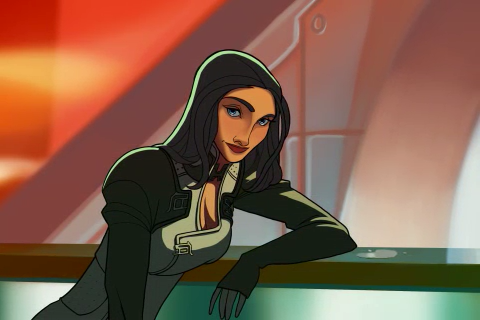 Mass Effect 2 [Bioware, 2010]'s Miranda Lawson, one of the example characters from my report.
During Week 1 I borrowed M. Krawczyk & J. Novak's 'Game Story & Character Development" from the University library.
I completed reading the book over the course of the week, and the source analysis report I wrote as a result can be found here.
"M. Krawczyk & J. Novak's 'Game Story & Character Development' is an important source for use with our project because its fifth, sixth and seventh chapters deal specifically with the traits our characters require to be believable. [...] This book has been a very useful source to study from both a theoretical and a practical standpoint. It has given rise to theoretical considerations such as to what extent a character is made from their design and their dialogue, and which traits are necessary and easy to replicate. From a practical standpoint it has enlightened us with regards to the danger of unsuited animations and voice acting, as well as providing a series of exercises that will help us create very well-rounded characters for use within our test."