
Week 2, Meeting 1:
Date: 16/02/2010
Time: 01:55pm until 02:20pm
Staff present: Claire Brierley
Location: C2 – 04a
A meeting took place at 01:55pm on the 16th of February with project supervisor, Claire Brierley. All five members of the team attended and several items regarding the project were discussed. We spoke about the research we had performed so far, the online blog and how the team had been working up until now.
Items addressed:
i. Existing Research.
ii. Further Research.
iii. Blog.
iv. Team structure.
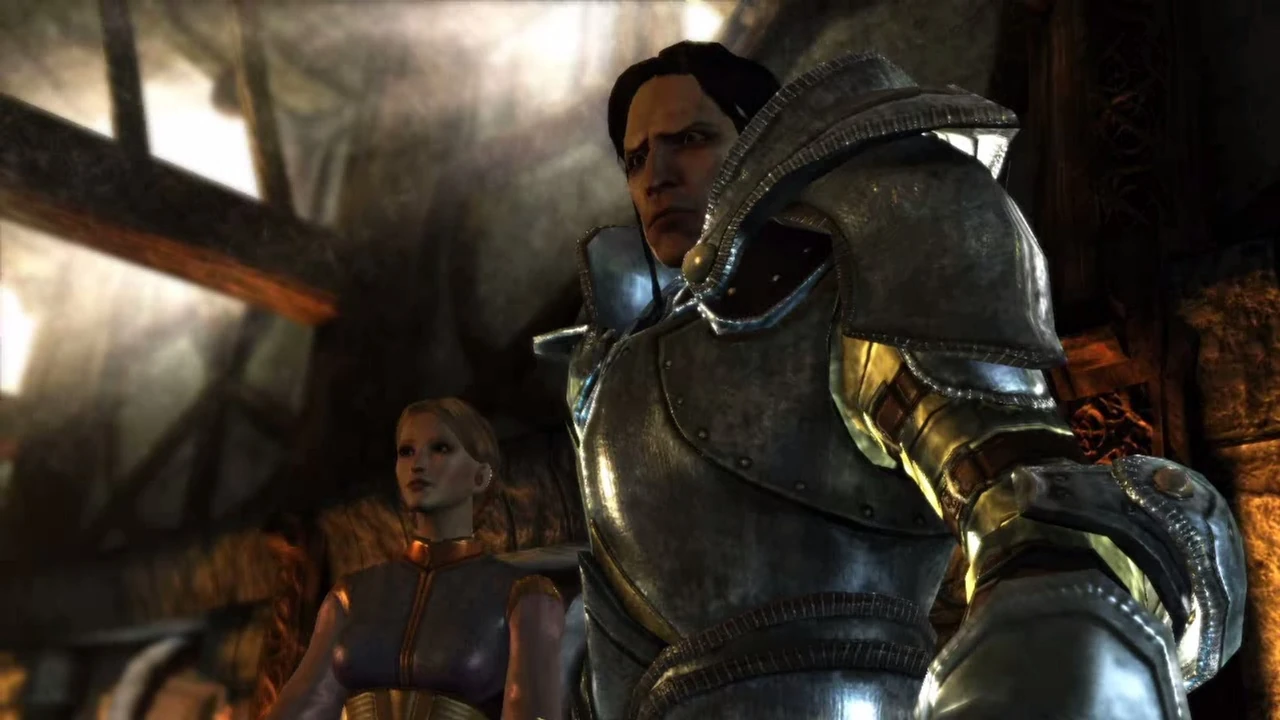 Dragon Age: Origins [Bioware, 2009]'s Loghain Mac Tir and the daughter he dotes upon, Anora.
For my first character study I chose Dragon Age's Loghain Mac Tir, reasoning that the game was still in my memory and I'd found the character incredibly compelling. The character study I wrote as a result can be found here.
"Bioware’s games are famed for their realistically-flawed and motivated characters. Their 2009 effort, Dragon Age: Origins is no different in this regard, and indeed is considered to have better characterisation than any of their other projects. The game pits the world-saving heroes of the Grey Wardens against a demonic horde set to overrun the country of Ferelden. Standing between the Grey Wardens and the unity required to stand against this Blight is general Loghain Mac Tir, Ferelden’s greatest hero and most valuable treasure, a man who truly represents the human ideal of hard work and dedication. A decisive, prideful and xenophobic man, Loghain’s defining character feature is that his ends always justify his means."
POSSIBLE TEST 1 - "THE MERCY TEST"
OVERVIEW:
Player and NPC (Villain) are seperated by an unbreakable glass wall at all times. As the player pursues the Villain the Villain releases AI enemies to harrass and defeat the player. Upon reaching the final room, however, the level diverges. The villain finds himself in a dead-end, and buttons in front of the player determine his fate. His reactions are as follows (numbers represent test configures):
1. Repentant - The Villain begs for the player's mercy and surrenders.
2. Arrogant - The Villain taunts the player.
The player then has the choice between the two buttons- Kill or Save.
Kill button - The Villain is killed by the room. A set time after the villain dies, the game ends automatically.
Save button - The Villain thanks the player for his kindness, and the game ends.
TESTING CONSIDERATIONS:
AIMS:
Players will either kill or spare our villain based on the characterisation we give them. This is a quick method of demonstrating whether or not players found our character believable, and will be backed up by the survey data they provide us.
PROS:
Players make a decision based on a judgement of an NPC they've had some manner of interaction with.
A life-and-death decision like this offers the player plenty of room for consideration.
CONS:
Would certain players be morally stronger? Thus, would they be less likely to even consider killing the villain?
Possibility of players for example sparing the Villain in the 2nd scenario, then killing him in the first simply to see the scene.
OTHER:
Playing the level more than once, the player knows what to expect- but they are then surprised by a different outcome. This test uses player choices as a barometer for testing the believability of our NPC and how engaging he is. This test also gathers certain ‘player choice’ data which can be an interesting field to consider in addition to how well our NPC worked.
MODIFICATIONS:
This test could be easily modified due to its simplistic nature. For example, a third option for the level could be to have the ‘Villain’ instead be a heroic character, who causes enemy-related problems for the player purely by accident. Would players make a snap decision regarding the value of the character’s life if they knew their troubles were simply accidental?
POSSIBLE TESTS:
POSSIBLE TEST 1 - "THE MERCY TEST" [PDF]
POSSIBLE TEST 2 - "THE FRIENDSHIP TEST" [PDF]
POSSIBLE TEST 3 -" THE SINISTER TWIN TEST" [PDF]
POSSIBLE TEST 4 -" THE MIRANDA PRINCIPLE" [PDF]
POSSIBLE TEST 5 -" THE FEMME FATALE TEST" [PDF]

The full downloadable .pdf version can be found here
As we build up a list of sources, I think we'd be best to find some way of organising them.
Should we list by quality/how useful the source is? Or by the field of the source?
Like Lewis said, we'll have quite a few by week ten (or even week three at this rate) so we should figure this out beforehand. Character and Game case studies break easily enough into their own sections, so they shouldn't be a problem.
While it is good to have this much written this soon it is a fact that most of these case studies are for our benefit more than the lecturers'.
What we are looking for in these character studies is not details on the character but what traits make them interesting to players. If it gets to week 10 and we have to trawl through 12k words for a few useful lines about what makes interesting/believable character we're going to regret it.
It's really good work thats been done so far though, it's just a little bit too much good work.
Any thoughts?
PS. This is being posted here because I will be far too tired to say this in any meaningful capacity tomorrow and it will be nice to show us using the blog for meaningful discussion.

As a part of the team's study into NPC characters, this week I researched the enigmatic Gman, from the Half Life series. The full case study can be found here.

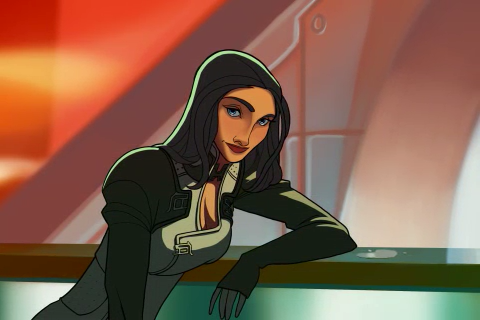 Mass Effect 2 [Bioware, 2010]'s Miranda Lawson, one of the example characters from my report.
During Week 1 I borrowed M. Krawczyk & J. Novak's 'Game Story & Character Development" from the University library.
I completed reading the book over the course of the week, and the source analysis report I wrote as a result can be found here.
"M. Krawczyk & J. Novak's 'Game Story & Character Development' is an important source for use with our project because its fifth, sixth and seventh chapters deal specifically with the traits our characters require to be believable. [...] This book has been a very useful source to study from both a theoretical and a practical standpoint. It has given rise to theoretical considerations such as to what extent a character is made from their design and their dialogue, and which traits are necessary and easy to replicate. From a practical standpoint it has enlightened us with regards to the danger of unsuited animations and voice acting, as well as providing a series of exercises that will help us create very well-rounded characters for use within our test."
The Title:
Creating interesting non-playable characters.
(Being a study into the contributing factors required to create interesting and believable characters within videogames.)
The Question:
What methods can we use to create realistic and engaging NPCs?
The Hypothesis:
If certain characteristics are considered more 'believable', then NPCs who have them will be more engaging to players.
Project Goals:
The ultimate goal of this project is to create some form of rule set for creating interesting Non Playable Characters (NPCs), and a clear explanation of the context these rules apply in. Through testing pre-defined characteristics that we theorise have positive or negative effects upon players, we should be able to create NPCs players consider 'realistic'. In order to reach this goal we will need to examine current thinking on the subject, case study games with interesting NPCs to look for common devices that we think make them interesting, and possibly distribute questionnaires/surveys to establish what type of person feels these characters are interesting, and how much they are in majority. Obviously it would be impossible to actually cover every possible device for making a character interesting and believable, so eventually it will be a requirement that we define the genre and subjects that will be tested (male 18-24).
The Test:
Our test will run a group of 'traditional videogamers' (males, 18-24) through a basic level and record their reaction to our NPC characters. We will gather qualitative and quantative data on their reactions through entry and exit questionnaires. To avoid an excessive number of personality variables, we must narrow down certain major traits. If we make characters too realistic (ie. totally multi-faceted) we will have far too many perspectives to test from. Our test framework must be such that variables can be changed without affecting the overall structure of the test. For example, making the character kind or callous- does the framework support this? By testing certain personality variables but leaving scope to modify them for repeat tests, we allow for the possibility of similar-conditions repeat testing.