
 GoldenEye: Source's remake of the Control level, Janus' secret Cuban base..
For a quick environment study I cast my memory back to the halcyon days of 1997, and the FPS phenomenon that was GoldenEye (and its namesake film), and decided to produce a quick overview of what we can learn from the two and how we can apply it to our forthcoming level design. Bond villains are the world's greatest super-villains, and their underground bases are a hallmark of the role. I'm sure there are other examples within the series, but here is the first..
"Possibly the best example of a villainous control room is that found in GoldenEye. Situated in Cuba and below a satellite dish (which is itself hidden under a lake), the Janus syndicate’s hidden base blends earth walls and polished, futuristic technology excellently. This is the kind of style we should be aiming to ape as it gives our level a sense of super-villainy, which will make the experience more fun. Having previously been made and remade in videogame form, GoldenEye is an excellent example for considering the addition of gameplay elements, and as one of the most famous FPSes in history, there’s no more deserving candidate of study."
As I meant to when writing the Source Analysis of The Silent Language, here is the accompanying breakdown of how the distances between characters are percieved, and how we can implement this into our test. I've also included a comparitive scale in Hammer units to help with both analysis and design. To download the document, click here.
"Elements Of Consideration"
being the most marvellous notes
of the renowned scholar Kyle Cherry
1.1 Refinement of our test.
-One of our current problems with the test is that we have not chosen a ‘victory condition’. This problem is easily remedied:
Our test has been successful if the player found the NPC too plausible as a friend to believe they could ever turn upon them. Essentially, that the ‘Nice’ level variant would be ‘canon’ in their eyes. One of the most important questions to include in the questionnaires is which level the player found most believable, because if our NPC is too friendly to be a threat players will tell us that the level where the two leave happily was the most believable. Our test will have been a success.
1.2 Defining sympathy, empathy and chivalry – Emotional Factors of our test.
“The Nature Of Sympathy”
(Max Scheler, 2008 / ISBN-10: 1412806879)
“The Role of Sympathy And Altruistic Personality Traits In Helping: A Reexamination”
(Nancy Eisenberg et al. / http://www3.interscience.wiley.com/journal/119431381/abstract)
“The Distinction Between Sympathy And Empathy”
(Lauren Wispé, 1986 / Journal of Personality And Social Psychology)
"The Sacred Rights Of The Weak"
(Elizabeth B. Clark, 1995 / http://www.jstor.org/pss/2082183)
2.1 Refinement of personality modelling chart to better suit our NPC.
-Reduce the variables -2/+2, representing the strongest realistic responses.
-Increase list of variables:
Hateful / Loving
Discontent / Content
Disillusioned / Hopeful
Cautious / Trusting
Cowardly / Courageous
Arrogant / Modest
Selfish / Selfless
Indifferent / Caring
Immature / Mature
Dishonorable /Honorable
-Addition of ‘Inert/Driven’ axis which charts the character’s ambition or lack thereof.
-Addition of ‘Independent/Dependent’ axis which charts the character’s need or lack of need for other characters.
-Addition of ‘Introvert/Extrovert’ axis which charts how the character presents themselves to social situations.
-Addition of ‘Chaotic/Ordered’ which charts the character’s attitudes to their clothing, possessions and situation.
We can use these personality modelling charts in our data-collection, asking players to mark the NPC. This is interesting, because with two NPCs to describe, the player will invariably pick the one they found most believable.
3.1 Design of our NPC – Career & Background.
-NPC must be sympathetic; unfulfilling day job? Money issues? NPC must be thoroughly sympathetic; Under-valued?
-Possible careers; IT Consultant, office drone.
When considering the chosen career of our NPC, we must pay attention to whether the setting places any additional restrictions on our character, for example ‘Job Strain’ and other traits.
“Does it matter where you work?"
(E. Jeffrey Hill, 2003 / Journal Of Vocational Behavior)
“A longitudinal test of Karasek's Job Strain model among office workers.”
(Pascale Carayon, 1993 / Work And Stress)
“A Brief Introduction to Job Strain”
(Peter Schnall M.D., 1998 / http://workhealth.org/strain/briefintro.html)
“The World Of The Office Worker”
(Michel Crozier, 1971 / Journal Of Contemporary Ethnography)
3.2 Design of our NPC – Appearance.
“A Measure Of Emotional Empathy”
(Albert Mehrabian, 2006 / http://dionysus.psych.wisc.edu/lit/Articles/MehrabianA1972a.pdf)
-Our NPC must be ‘average’ to best fit plausibility;
“Why are average faces attractive?”
(Tim Valentine, 2004 / http://www.valentinemoore.co.uk/trv/Attractive.pdf)
“Eyeglasses and gender stereotypes.”
(Roger Terry, 1989 / http://journals.lww.com/optvissci/Abstract/1989/10000/Eyeglasses_and_Gender_Stereotypes.6.aspx)
-This study suggests that women with glasses are considered to be more intelligent, feminine and introverted than otherwise.
"What is the female image projected by smoking?"
(John Beech, 2001 / http://www.le.ac.uk/psychology/jrb/PDF2000/Beech&Whittaker01.pdf)
-This study shows how smoking is considered to make a female seem more sexually interested, and glasses more intelligent. Variables such as these can easily be added to our character to make them seem more realistic, and the effects are clear for us to see.
4.1 Design of our Level - Situation.
-An everyday setting plays well to the strengths of the Hammer editor. IE; streets, shops.
-Setting must be fairly normalised so that the player is less concerned with that than with the NPC herself. IE; an alien invasion would have the players looking for aliens instead of interacting with our NPC, and would render our test useless.
“Fear of Crime and Handgun Ownership”
(James DeFronzo, 2006 / http://www3.interscience.wiley.com/journal/119597174/abstract?CRETRY=1&SRETRY=0)
“Determinants of fear of crime: The effect of cultural setting”
(Richard Bennet, 1994 / http://www.informaworld.com/smpp/content~content=a718869555&db=all)
-The two above are important to consider if we plan to use many firearms upon our level- how did they get there?
The link below is an interesting proposition to consider if we stick with horror elements in a civilised setting.
“Setting in Horror Fiction"
(Teresa Hopper, 2002 / http://www.fmwriters.com/Visionback/Issue9/horror.htm)
Above all, the rule of a normalised setting must be upheld, otherwise we risk spoiling the test with nonsense.
4.2 Design of our Level - Layout.
-The level must incorporate spaces for the player to directly interact with the NPC (through triggers, essentially ‘helpful’ and ‘unhelpful’) so we can better directly monitor the two. This can also play to the idea of using Bioware-esque conversational trees.
“Sick Building Syndrome: A Study Of 4373 Office Workers"
(Sherwood Burge, 1987 / http://annhyg.oxfordjournals.org/cgi/content/abstract/31/4A/493)
“Non-Specific Symptoms In Office Workers”
(Mark Mendell, 2004 / http://www3.interscience.wiley.com/journal/119306861/abstract?CRETRY=1&SRETRY=0)
5.1 Further Reading.
“Consistency of personality in interactive characters”
(Katherine Isbister, 2000 / http://www.fineminddesign.com/site/media/Readings/Week%208/Isbister_nass_2000_consistency_of_personality_in_interactive_characters.pdf )
“Engaging Characters: Fiction, Emotion, and the Cinema”
(Murray Smith, 1995 / ISBN-10: 019818347X)
Research on tabletop games- how do they encourage creating and playing believable characters?
Since Easter is a three-week break with no chance for formal meetings and probably quite infrequent team communication, we should all focus our research towards things to add to the level, NPC and testing*, as well as uploading any outstanding work. Following are the guidlines to refer to:
i. All notes & research work must contain appropriate citations (or inferences as a last resort).
For example: If adding zombies will make our level scarier, why? Who has proven this previously?
ii. All notes & research work is to be delivered in a team meeting once the break is over.
iii. Any pieces completed during the break (ie. Source Analyses, Character Studies) can be uploaded to the blog as they are finished as usual.
iv. Tag all Easter work with the 'Easter' tag in place of a week number.
v. Outstanding pieces such as the Zevran Character Study and the Half-Life Models report are also to be posted during this break, so that everyone is up to date upon our return.
vi. Have fun and be productive! Big brother is watching you!
*things such as 'Why are military uniforms intimidating?', 'Why are office clothes conformist?' and 'What is the effect of teleporting an alien squid into New York City?'
 Players in Warhammer Online: Age Of Reckoning demonstrate distances in MMORPGs.
"E. Hall's 'The Silent Language’ is an interesting source describing the myriad aspects of culture. While the book is probably required reading for anthropologists, I at first struggled to find meaning within it as relating to games design. Nonetheless riveting, it was only as I approached chapter ten, ‘Space Speaks’, which discusses from a Western point of view how distance affects communication. Within a three-dimensional space such as our level, this is integral."
From the start of our project I wanted to hit the ground running with a quick survey to ask what traits were especially pronounced among characters of the recently-released Dragon Age: Origins. I decided the quickest way to do this was to produce a survey asking respondents to rank the game’s eight characters in order of how much the characters appealed to them. I distributed the completed survey to two groups of people; a group of predominantly-female Bioware fans on a Bioware fansite, and a predominantly-male group of games students. The information provided by the characters Morrigan, Alistair, Loghain and Oghren will be the most important, for reasons I will explain upon analysing the data (should my theories hold true.) The survey I performed and its analysis can be found here.
During my analysis of C.Crawford’s ‘Chris Crawford On Interactive Storytelling’ I discovered the concept of ‘personality mapping’- creating an image of a character through a series of traits that make them up. Comparing this with what I learnt from M. Krawczyk regarding a list of traits to look out for in characters, I had the idea of mapping the positive and negative traits suggested by Krawczyk to a -5 to +5 axis representing the strength. I theorised that with a list of characteristics scored either positive or negative, we would be able to make a character that was plausible for a realistic setting, and could then modify that to easily fit new characters. The test I performed and its analysis can be found here.
 Mass Effect 2 [Bioware, 2010]'s sexy super-spy Miranda Lawson.
For my second character study I chose Mass Effect 2's Miranda Lawson, reasoning that as I'd used her as an example previously, and that we'd named one of our possible tests in her honour, I should explain her importance. The character study I wrote as a result can be found here.
"Mass Effect 2 is a strange game. On the one hand, it represents something of a technical step back from Dragon Age’s approval system, replacing a slow build of trust with a one-shot mission to prove your loyalty. On the other hand, the characterisation is as good if not better, and I feel this is typified by Miranda Lawson, Commander Shepard’s second in command. Ostensibly a spy working for the mysterious Illusive Man, and indeed the only person in the galaxy who ever meets him in person, Miranda is both the stereotypical femme fatale; a sexy, sassy character almost painted into her uniform, and something entirely different. That she fits the setting so well and breaks beyond her stereotype are both testament to the skill of Bioware’s writers."
 Marvel Comics' The Sentry, the golden guardian of good... and bad?
During Week 3 I researched Personality Theory & Archetypes, and compared what I'd learnt to my existing knowledge of superhero comic-books and films. The report I wrote as a result can be found here.
"When designing characters to engage the player there are a multitude of elements to consider, such as the visual and auditory design of the characters, as well as their personality. These design elements become especially important when creating characters a player will only interact with for a short time, as a lot of the player’s opinion is formed with the first impression."
 Dragon Age: Origins [Bioware, 2010]'s Alistair and Morrigan, the example characters from my report.
During Week 3 I borrowed C. Crawford's 'Chris Crawford On Interactive Storytelling" from the University library.
I completed reading the book over the course of the week, and the source analysis report I wrote as a result can be found here.
"C. Crawford’s 'Chris Crawford On Interactive Storytelling’1 is an intriguing book. On the one hand, it provides deep and detailed information regarding any way that plot and characters can be used in videogames, but on the other hand, is presented in such a confrontational and condescending way it’s hard to take the man seriously. This stems from the fact that while Crawford practically invented his field, other writers were published dealing with it prior to him, and there seems a kind of resentment present. Struggling through this, however, I found the book to be an excellent source for our project, as it presents further development in the ‘Personality Modelling’ I’ve been working on. While the entire book is useful from a narrative perspective, we are only concerned with Chapter 11, which deals with character-driven storytelling and believable NPCs."
I've begun the 'Source Bible' of all of the sources used by research in Project Skills and in this unit. As this will be completely iterative, could I please request team members take a little more care with their referencing? Simple things such as giving the title of a paper without a URL for easy viewing, or citing a book without its ISBN. Other than that, I'm very happy to see several sources cited across multiple pieces of work (even one source across FOUR seperate pieces), let's keep that up, too!
Also, a minor update with regards to my Research Survey. The Mass Effect survey is being cancelled due to lack of replies, and I've still to recieve completed Dragon Age surveys from the team and from our second testing group. I'd be particularly grateful if this situation could be wrapped up by Sunday. For those who missed the link last time, they're here.
 Street Fighter II [Capcom, 1991]'s Chun Li battles the monstrous Blanka on the game's US Box Art.
During Week 2 I borrowed S. Graner Ray's 'Gender-Inclusive Games Design" from the University library.
I completed reading the book over the course of the week, and the source analysis report I wrote as a result can be found here.
”S. Graner Ray’s 'Gender-Inclusive Games Design’ is an unlikely source to draw upon for our project, but ultimately it proved at least a little rewarding. The book’s basic premise is that with Games Design being a male-orientated field, more should be done to make games accessible to females- after all, half the planet is female, and that’s a massive untapped market. Appealing directly to our project, however, are elements of chapters two and seven, ‘Evolution Of Female Characters In Computer Games’ and ‘Avatar Selection’ respectively. These were the titles that originally drew me to read the book, and they have proved quite interesting."
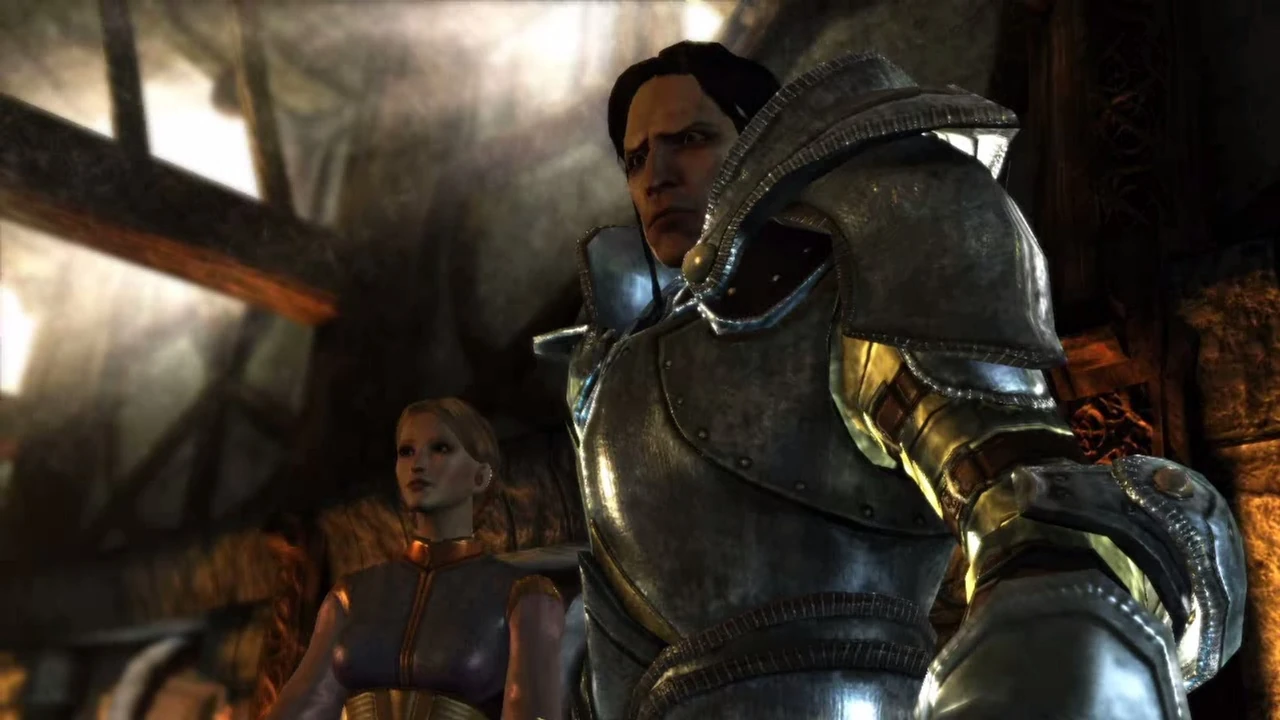 Dragon Age: Origins [Bioware, 2009]'s Loghain Mac Tir and the daughter he dotes upon, Anora.
For my first character study I chose Dragon Age's Loghain Mac Tir, reasoning that the game was still in my memory and I'd found the character incredibly compelling. The character study I wrote as a result can be found here.
"Bioware’s games are famed for their realistically-flawed and motivated characters. Their 2009 effort, Dragon Age: Origins is no different in this regard, and indeed is considered to have better characterisation than any of their other projects. The game pits the world-saving heroes of the Grey Wardens against a demonic horde set to overrun the country of Ferelden. Standing between the Grey Wardens and the unity required to stand against this Blight is general Loghain Mac Tir, Ferelden’s greatest hero and most valuable treasure, a man who truly represents the human ideal of hard work and dedication. A decisive, prideful and xenophobic man, Loghain’s defining character feature is that his ends always justify his means."
POSSIBLE TEST 1 - "THE MERCY TEST"
OVERVIEW:
Player and NPC (Villain) are seperated by an unbreakable glass wall at all times. As the player pursues the Villain the Villain releases AI enemies to harrass and defeat the player. Upon reaching the final room, however, the level diverges. The villain finds himself in a dead-end, and buttons in front of the player determine his fate. His reactions are as follows (numbers represent test configures):
1. Repentant - The Villain begs for the player's mercy and surrenders.
2. Arrogant - The Villain taunts the player.
The player then has the choice between the two buttons- Kill or Save.
Kill button - The Villain is killed by the room. A set time after the villain dies, the game ends automatically.
Save button - The Villain thanks the player for his kindness, and the game ends.
TESTING CONSIDERATIONS:
AIMS:
Players will either kill or spare our villain based on the characterisation we give them. This is a quick method of demonstrating whether or not players found our character believable, and will be backed up by the survey data they provide us.
PROS:
Players make a decision based on a judgement of an NPC they've had some manner of interaction with.
A life-and-death decision like this offers the player plenty of room for consideration.
CONS:
Would certain players be morally stronger? Thus, would they be less likely to even consider killing the villain?
Possibility of players for example sparing the Villain in the 2nd scenario, then killing him in the first simply to see the scene.
OTHER:
Playing the level more than once, the player knows what to expect- but they are then surprised by a different outcome. This test uses player choices as a barometer for testing the believability of our NPC and how engaging he is. This test also gathers certain ‘player choice’ data which can be an interesting field to consider in addition to how well our NPC worked.
MODIFICATIONS:
This test could be easily modified due to its simplistic nature. For example, a third option for the level could be to have the ‘Villain’ instead be a heroic character, who causes enemy-related problems for the player purely by accident. Would players make a snap decision regarding the value of the character’s life if they knew their troubles were simply accidental?
POSSIBLE TESTS:
POSSIBLE TEST 1 - "THE MERCY TEST" [PDF]
POSSIBLE TEST 2 - "THE FRIENDSHIP TEST" [PDF]
POSSIBLE TEST 3 -" THE SINISTER TWIN TEST" [PDF]
POSSIBLE TEST 4 -" THE MIRANDA PRINCIPLE" [PDF]
POSSIBLE TEST 5 -" THE FEMME FATALE TEST" [PDF]
As we build up a list of sources, I think we'd be best to find some way of organising them.
Should we list by quality/how useful the source is? Or by the field of the source?
Like Lewis said, we'll have quite a few by week ten (or even week three at this rate) so we should figure this out beforehand. Character and Game case studies break easily enough into their own sections, so they shouldn't be a problem.
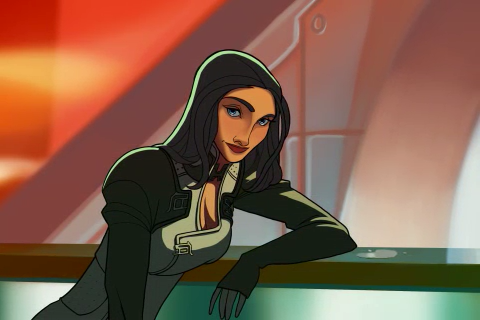 Mass Effect 2 [Bioware, 2010]'s Miranda Lawson, one of the example characters from my report.
During Week 1 I borrowed M. Krawczyk & J. Novak's 'Game Story & Character Development" from the University library.
I completed reading the book over the course of the week, and the source analysis report I wrote as a result can be found here.
"M. Krawczyk & J. Novak's 'Game Story & Character Development' is an important source for use with our project because its fifth, sixth and seventh chapters deal specifically with the traits our characters require to be believable. [...] This book has been a very useful source to study from both a theoretical and a practical standpoint. It has given rise to theoretical considerations such as to what extent a character is made from their design and their dialogue, and which traits are necessary and easy to replicate. From a practical standpoint it has enlightened us with regards to the danger of unsuited animations and voice acting, as well as providing a series of exercises that will help us create very well-rounded characters for use within our test."
The Title:
Creating interesting non-playable characters.
(Being a study into the contributing factors required to create interesting and believable characters within videogames.)
The Question:
What methods can we use to create realistic and engaging NPCs?
The Hypothesis:
If certain characteristics are considered more 'believable', then NPCs who have them will be more engaging to players.
Project Goals:
The ultimate goal of this project is to create some form of rule set for creating interesting Non Playable Characters (NPCs), and a clear explanation of the context these rules apply in. Through testing pre-defined characteristics that we theorise have positive or negative effects upon players, we should be able to create NPCs players consider 'realistic'. In order to reach this goal we will need to examine current thinking on the subject, case study games with interesting NPCs to look for common devices that we think make them interesting, and possibly distribute questionnaires/surveys to establish what type of person feels these characters are interesting, and how much they are in majority. Obviously it would be impossible to actually cover every possible device for making a character interesting and believable, so eventually it will be a requirement that we define the genre and subjects that will be tested (male 18-24).
The Test:
Our test will run a group of 'traditional videogamers' (males, 18-24) through a basic level and record their reaction to our NPC characters. We will gather qualitative and quantative data on their reactions through entry and exit questionnaires. To avoid an excessive number of personality variables, we must narrow down certain major traits. If we make characters too realistic (ie. totally multi-faceted) we will have far too many perspectives to test from. Our test framework must be such that variables can be changed without affecting the overall structure of the test. For example, making the character kind or callous- does the framework support this? By testing certain personality variables but leaving scope to modify them for repeat tests, we allow for the possibility of similar-conditions repeat testing.