
As part of the team's ongoing research, I've looked into testing methodology using the book "Game Usability: Advice from the experts for advancing the players experience" written by Katherine Isbister and Noah Schaffer as my source. I've created a two page document discussing the relevant information found in Chapters VII, IX and XV and given an insight as to how we can use the information gathered in testing of our own.
Week 2, Meeting 1:
Date: 16/02/2010
Time: 01:55pm until 02:20pm
Staff present: Claire Brierley
Location: C2 – 04a
A meeting took place at 01:55pm on the 16th of February with project supervisor, Claire Brierley. All five members of the team attended and several items regarding the project were discussed. We spoke about the research we had performed so far, the online blog and how the team had been working up until now.
Items addressed:
i. Existing Research.
ii. Further Research.
iii. Blog.
iv. Team structure.
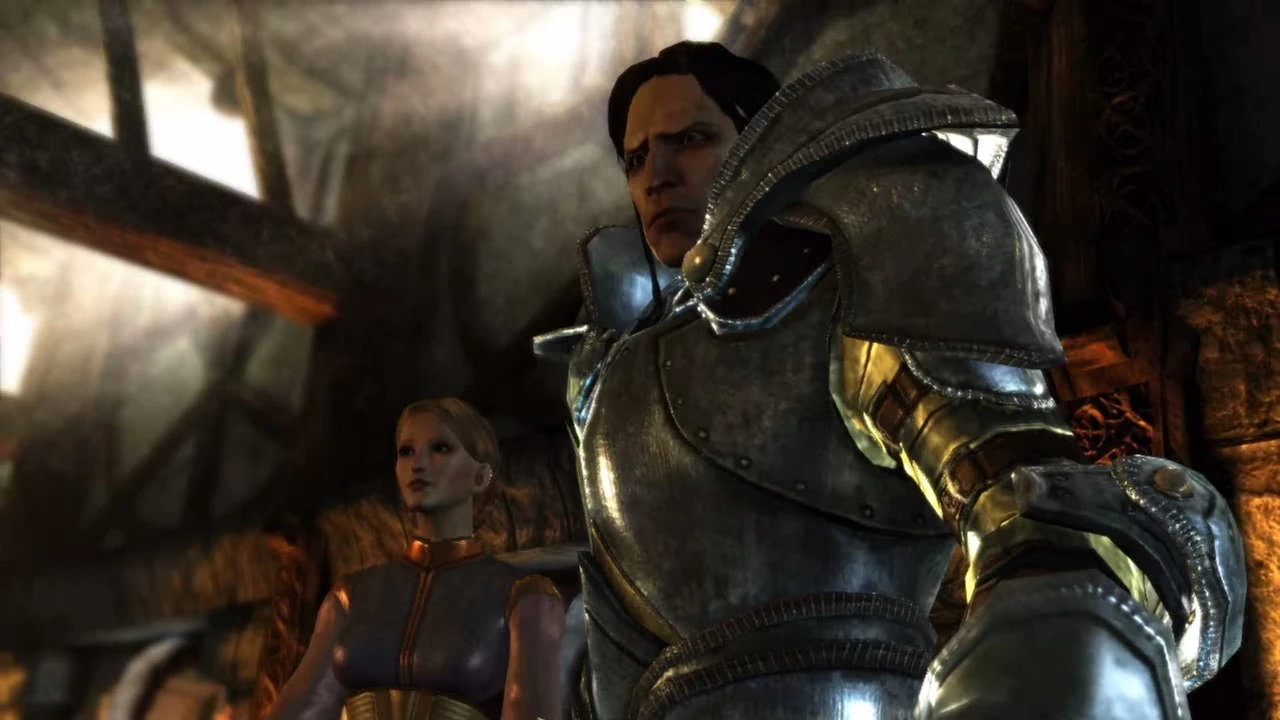 Dragon Age: Origins [Bioware, 2009]'s Loghain Mac Tir and the daughter he dotes upon, Anora.
For my first character study I chose Dragon Age's Loghain Mac Tir, reasoning that the game was still in my memory and I'd found the character incredibly compelling. The character study I wrote as a result can be found here.
"Bioware’s games are famed for their realistically-flawed and motivated characters. Their 2009 effort, Dragon Age: Origins is no different in this regard, and indeed is considered to have better characterisation than any of their other projects. The game pits the world-saving heroes of the Grey Wardens against a demonic horde set to overrun the country of Ferelden. Standing between the Grey Wardens and the unity required to stand against this Blight is general Loghain Mac Tir, Ferelden’s greatest hero and most valuable treasure, a man who truly represents the human ideal of hard work and dedication. A decisive, prideful and xenophobic man, Loghain’s defining character feature is that his ends always justify his means."
POSSIBLE TEST 1 - "THE MERCY TEST"
OVERVIEW:
Player and NPC (Villain) are seperated by an unbreakable glass wall at all times. As the player pursues the Villain the Villain releases AI enemies to harrass and defeat the player. Upon reaching the final room, however, the level diverges. The villain finds himself in a dead-end, and buttons in front of the player determine his fate. His reactions are as follows (numbers represent test configures):
1. Repentant - The Villain begs for the player's mercy and surrenders.
2. Arrogant - The Villain taunts the player.
The player then has the choice between the two buttons- Kill or Save.
Kill button - The Villain is killed by the room. A set time after the villain dies, the game ends automatically.
Save button - The Villain thanks the player for his kindness, and the game ends.
TESTING CONSIDERATIONS:
AIMS:
Players will either kill or spare our villain based on the characterisation we give them. This is a quick method of demonstrating whether or not players found our character believable, and will be backed up by the survey data they provide us.
PROS:
Players make a decision based on a judgement of an NPC they've had some manner of interaction with.
A life-and-death decision like this offers the player plenty of room for consideration.
CONS:
Would certain players be morally stronger? Thus, would they be less likely to even consider killing the villain?
Possibility of players for example sparing the Villain in the 2nd scenario, then killing him in the first simply to see the scene.
OTHER:
Playing the level more than once, the player knows what to expect- but they are then surprised by a different outcome. This test uses player choices as a barometer for testing the believability of our NPC and how engaging he is. This test also gathers certain ‘player choice’ data which can be an interesting field to consider in addition to how well our NPC worked.
MODIFICATIONS:
This test could be easily modified due to its simplistic nature. For example, a third option for the level could be to have the ‘Villain’ instead be a heroic character, who causes enemy-related problems for the player purely by accident. Would players make a snap decision regarding the value of the character’s life if they knew their troubles were simply accidental?
POSSIBLE TESTS:
POSSIBLE TEST 1 - "THE MERCY TEST" [PDF]
POSSIBLE TEST 2 - "THE FRIENDSHIP TEST" [PDF]
POSSIBLE TEST 3 -" THE SINISTER TWIN TEST" [PDF]
POSSIBLE TEST 4 -" THE MIRANDA PRINCIPLE" [PDF]
POSSIBLE TEST 5 -" THE FEMME FATALE TEST" [PDF]