

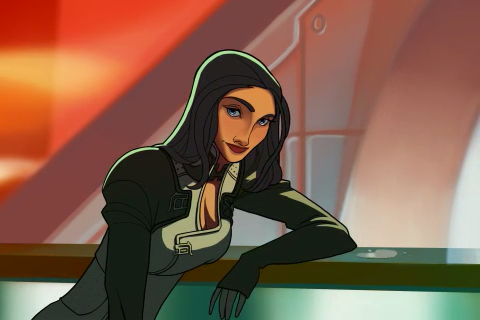
 Mass Effect 2 [Bioware, 2010]'s Miranda Lawson, one of the example characters from my report.
During Week 1 I borrowed M. Krawczyk & J. Novak's 'Game Story & Character Development" from the University library.
I completed reading the book over the course of the week, and the source analysis report I wrote as a result can be found here.
"M. Krawczyk & J. Novak's 'Game Story & Character Development' is an important source for use with our project because its fifth, sixth and seventh chapters deal specifically with the traits our characters require to be believable. [...] This book has been a very useful source to study from both a theoretical and a practical standpoint. It has given rise to theoretical considerations such as to what extent a character is made from their design and their dialogue, and which traits are necessary and easy to replicate. From a practical standpoint it has enlightened us with regards to the danger of unsuited animations and voice acting, as well as providing a series of exercises that will help us create very well-rounded characters for use within our test."
The Title:
Creating interesting non-playable characters.
(Being a study into the contributing factors required to create interesting and believable characters within videogames.)
The Question:
What methods can we use to create realistic and engaging NPCs?
The Hypothesis:
If certain characteristics are considered more 'believable', then NPCs who have them will be more engaging to players.
Project Goals:
The ultimate goal of this project is to create some form of rule set for creating interesting Non Playable Characters (NPCs), and a clear explanation of the context these rules apply in. Through testing pre-defined characteristics that we theorise have positive or negative effects upon players, we should be able to create NPCs players consider 'realistic'. In order to reach this goal we will need to examine current thinking on the subject, case study games with interesting NPCs to look for common devices that we think make them interesting, and possibly distribute questionnaires/surveys to establish what type of person feels these characters are interesting, and how much they are in majority. Obviously it would be impossible to actually cover every possible device for making a character interesting and believable, so eventually it will be a requirement that we define the genre and subjects that will be tested (male 18-24).
The Test:
Our test will run a group of 'traditional videogamers' (males, 18-24) through a basic level and record their reaction to our NPC characters. We will gather qualitative and quantative data on their reactions through entry and exit questionnaires. To avoid an excessive number of personality variables, we must narrow down certain major traits. If we make characters too realistic (ie. totally multi-faceted) we will have far too many perspectives to test from. Our test framework must be such that variables can be changed without affecting the overall structure of the test. For example, making the character kind or callous- does the framework support this? By testing certain personality variables but leaving scope to modify them for repeat tests, we allow for the possibility of similar-conditions repeat testing.
Week 1, Meeting 1:
Date: 09/02/2010
Time: 01:45pm until 02:10pm
Staff present: Claire Brierley
Location: C2 – 04a
A meeting took place at 01:45pm on the 9th of February with project supervisor, Claire Brierley. All five members of the team attended and several items regarding the unit and project were discussed. We spoke about each of the group members individual roles, if they were happy with those roles and about any initial ideas we had for our project question and how we could solve it.
Items addressed:
i. Group Members.
ii. Project Proposal.
iii. Initial ideas.
iv. Team structure.
v. Goals for following week.
Below is a list of all work completed for the Level 3 Team Project unit:
Team Fable Source Bible
Assessments:
Design Document, Pitch and Plan
Test Planning Documentation
Pitch and Plan Presentation
Milestone I Presentation - Research
Milestone II Presentation - Level Design
Milestone III Presentation - Test Planning
Milestone IV Presentation - Final Artefact
Milestone V Presentation - Analysis and Conclusion
Case Studies:
01. Human Emotion - Empathy and Sympathy
02. Human Emotion - Empathy, Chivalry and Sympathy
Character Studies:
Character Study - Elika (Prince of Persia)
Character Study - Frank Fontaine (Bioshock)
Character Study - Miranda Lawson (Mass Effect 2)
Character Study - Loghain Mac Tir (Dragon Age)
Character Study - The Gman (Half Life 2)
Other Characterisation:
Analysis Of Characters Within Fable II
Analysis Of Characters Within Warhammer 40,000
Comic-Book Characterisation & Personality Theory
NPCs And Visual Information [Part 1]
NPCs And Visual Information [Part 2]
Source Analysis:
Better Games Characters By Design (K. Isbister)
Consistency of Personality in Interactive Characters (K. Isbister, C. Nass)
Creating Emotions in Games: The Craft and Art of Emotioneering (D. Freeman)
Game Usability: Advice From The Experts For Advancing The Player Experience (K. Isbister & N. Schaffer)
Gender-Inclusive Games Design (S. Graner Ray)
Game Story And Character Development (M. Krawczyk & J. Novak)
Chris Crawford On Interactive Storytelling (C. Crawford)
The Art of Game Characters (L. Hartas)
Understanding Emotions (K. Oatley, D. Kelt, J.M. Jenkins)
The Silent Language (E. Hall)
Games Design Complete (P. O'Luanaigh)
Environment Studies:
Environment Study - GoldenEye's Janus Syndicate Base
Environment Study - Left 4 Dead's 'Dead Air' Office Complex
Other Research:
Kyle Cherry - Project Skills Assignment 2
Adam Parker - Project Skills Assignment 2
Adam Parker - Project Skills Poster
Project Methodology Report
Research Exercise - Dragon Age Survey
Research Exercise - Personality Modelling